
As an eye specialist, I see that more children have increased eye power, and more adults are developing myopia earlier than before. Nowadays, changes in lifestyle can be a reason behind this.
Lifestyle habits like excessive screen use are also linked to computer vision syndrome and eye strain, which can gradually affect visual clarity.
Have you ever noticed your child spending more time on a tablet or phone than playing outside? So, many parents come to us and ask, “Why is my child’s eye power rising fast? How to control it?
For this, it is important to understand what myopia is, why it occurs, and how it can be managed.
In this guide, you will learn what causes myopia and how to spot myopia early in your child. Also, you understand how we help protect your eyes by providing advanced treatment at Nihar Netralaya in Indore.
What Is Myopia (Short-Sightedness)?
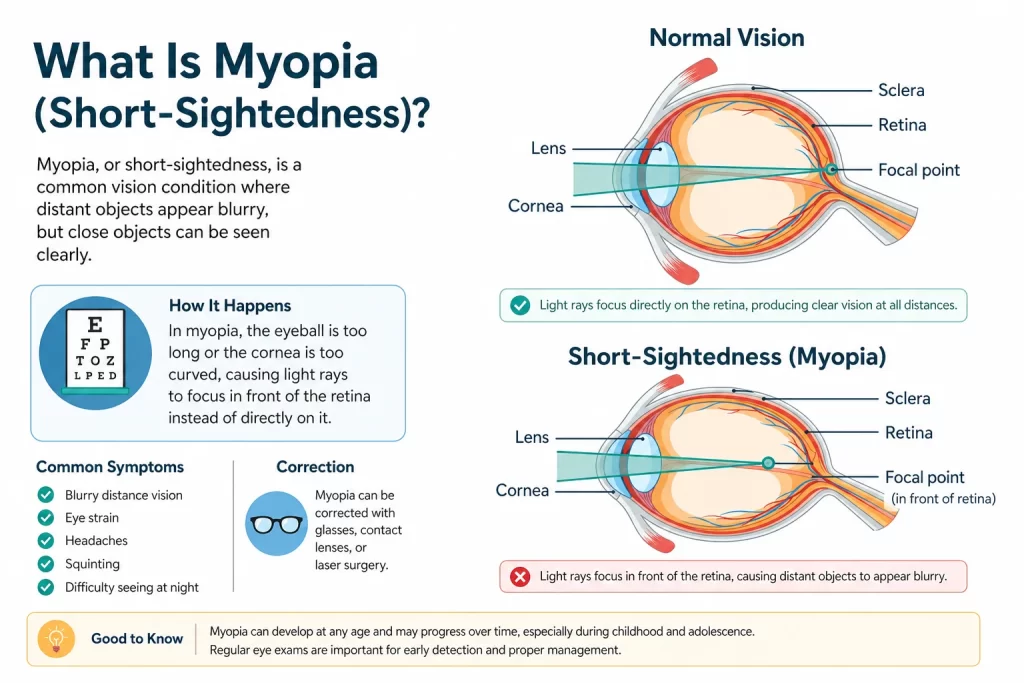
Myopia is an eye condition where you can see objects clearly that are near. But you cannot see distant or far objects clearly; they appear blurry to you. Myopia, also known as refractive error or shortsightedness.
Refractive errors like myopia are commonly corrected using options such as LASIK surgery or prescription lenses. For example, your child can read a book clearly, but reading the classroom board is difficult.
It mostly starts to develop in childhood when your child’s eyes are growing. In India, it has risen rapidly among children aged 5-15 years to around 22%. By 2050, around 1 in 2 Indian children could be affected by myopia.
Myopia is not only related to childhood-focused eye conditions. A South Indian study found myopia is seen in 35.6% of adults.
But the question is, what causes myopia? Let’s look at how myopia develops and how certain factors can increase the risk.
What Causes Myopia? Common Causes and Risk Factors
The exact causes of myopia are not known. But it may be due to structural eye defects or to genetic and environmental causes.
Usually, clear vision happens when light hits your retina at the back of your eye. In myopia, your eyeball grows too long, a condition called eyeball elongation. The cornea, which is placed in your eye’s front layer, curves more than normal. As a result, light focuses in front of your retina.
Beyond these eye changes, some factors may increase the risk of developing or worsening myopia.
Here are the risk factors of myopia:
- Family history (Genetic factors): If you or your partner has myopia, the chances of myopia are high in your child.
- Too much close-up work: When your child spends most of their time on screen, that increases the risk. Also, in adults who work long hours, such as reading and spending more time on the computer.
- Limited outdoor activity: This can limit natural exposure to sunlight for your child, which contributes to myopia. As per AAO, increasing time on outdoor activity can help in reducing the risk of myopia.
Developing simple eye protection habits can also support long-term eye health and reduce strain.
Myopia Symptoms: How to Know If Your Child Is Short-Sighted
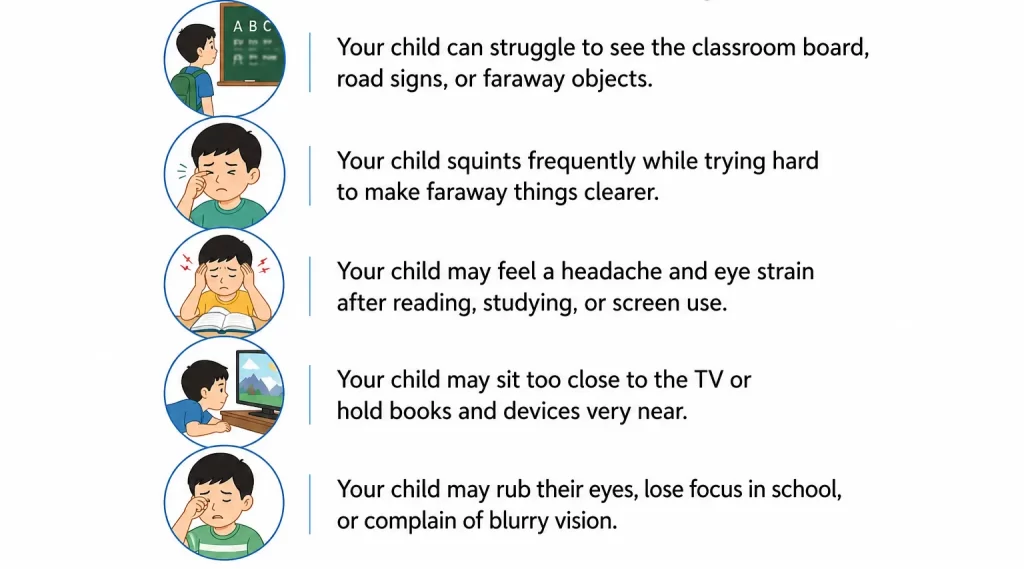
It is important to recognize myopia symptoms in your child to help ensure timely treatment.
Common myopia symptoms that help you know your child has short-sightedness:
- Your child can struggle to see the classroom board, road signs, or faraway objects.
- Your child squints frequently while trying hard to make faraway things clearer.
- Your child may feel a headache and eye strain after reading, studying, or screen use.
- Your child may sit too close to the TV or hold books and devices very near.
- Your child may rub their eyes, lose focus in school, or complain of blurry vision.
If you notice these signs, an eye check‑up with the best eye specialist can help protect your child’s vision early. Some of these signs may also be seen in conditions like squint in children, which should be evaluated early.
Types of Myopia: From Mild to High Myopia
Myopia is not the same for everyone; it can vary based on how severe it is, what causes it, and how fast it progresses.
| Type | How does it show up |
| Mild or Moderate Myopia | It is the most common type of myopia. Your child has blurred distance vision and needs glasses. |
| High Myopia | It is a severe form of myopia that requires close monitoring of your child. |
| Progressive Myopia | Eye power increases as your child grows. |
| Pathological Myopia | Your child may develop advanced changes linked with severe eye structure changes. |
| Axial Myopia | A common type where the eyeball grows longer than normal. |
In advanced cases, complications may involve the retina, where treatments like laser retinal treatment are considered when required.
Can Myopia Be Cured Permanently?
This is the most frequent question our patients ask. So, myopia can not be cured permanently, but it can be corrected and managed through the following ways:
- Glasses and contact lenses are the common and safest treatments to help correct blurred vision in your child.
- For young adults, myopic laser surgery, such as LASIK surgery, is a good option to reshape the cornea.
- Spending time outdoors may support your child’s healthy visual development.
- When using screens, try the 20‑20‑20 habit: every 20 minutes, look away for 20 seconds at something about 20 feet away, the simplest way to rest eyes.
Advanced Myopia Control Treatments at Nihar Netralaya, Indore
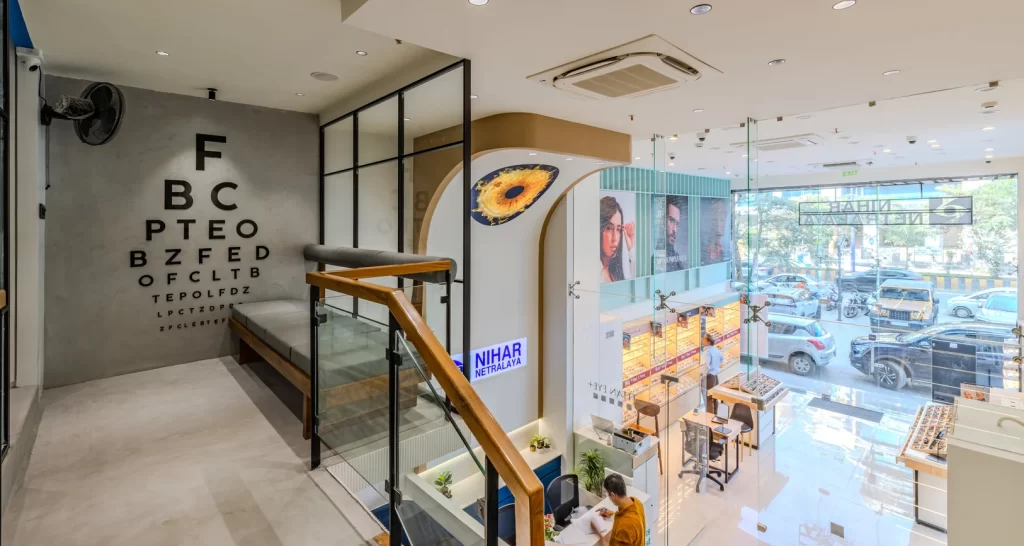
At Nihar Netralaya, in Indore, we offer evidence-based solutions for myopia treatment to all our patients. For myopia, we provide multiple myopia control technologies under one roof.
Our myopia treatment plan for our patients is personalized based on your age, eye condition, progression and budget.
At our clinic, you have access to global myopia control brands and the latest innovations beyond regular glasses. This includes:
- ZEISS Myopia Control Lenses are offered through a ZEISS-certified myopia control clinic and are designed to help manage progression.
- Titan Eye+ optical within the clinic, so you get consultation and eyewear solutions in one place.
- Another advanced lens, HOYA Myopia Control Lenses, is designed for children with increasing eye power.
- Essilor Stellest lenses offer another advanced spectacle option to help manage your child’s myopia progression.
For personalized myopia care, we provide the following evaluations and treatments in our eye clinic in Indore:
- We carefully examine your eyes and track the progression of myopia over time. Regular eye exams also help detect early signs of conditions like glaucoma that may not show symptoms initially.
- We plan your treatment based on your age, eye power, and lifestyle for the best results.
- We give special attention to children whose eye power continues to increase.
- We also provide parents and our patients with practical guidance on screen use and outdoor play to protect vision.
- We offer advanced procedures such as LASIK surgery, phakic intraocular lenses (ICLs), and orthokeratology when needed.
Why Choose Nihar Netralaya for Myopia Control in Indore?

Nihar Netralaya is a ZEISS-certified clinic for myopia control in Indore. We combine specialized myopia and eye allergy expertise with personalized and child‑friendly care. We offer multiple advanced lens technologies and have in‑house Titan Eye+ optical for easy fitting and guidance.
You may find our care especially helpful if your child’s eye power is increasing and you are seeking myopia solutions, or if you experience eye strain, itching, or blurred vision.
Patients can access eye care at two centres in Indore:
- Nihar Netralaya – Best Eye Hospital in Indore: 3, Gulab Park Colony, Rajmohalla Square, Mahesh Nagar
- Nihar Netralaya – Advanced Eye Care Center: Shanti Dazzle, near Agarwal Public School, Scheme No. 140
Early myopia care helps protect your vision for the long term. With timely eye check‑ups and advanced control options, you and your child can take steps toward better eye health.
Understanding different specs removal procedures can also help you explore long-term vision correction options.
FAQs
Myopia often begins in childhood, typically between the ages of 6 and 14, and may progress as the child grows.
Yes, myopia can increase as the eye continues to grow, especially during school years and teenage years. In most cases, it stabilizes in the late teens or early 20s.
Screen time does not directly cause myopia, but excessive use can increase eye strain and may contribute to faster progression, especially in children.
Encouraging outdoor play, limiting screen time, following the 20-20-20 rule, and regular eye check-ups can help slow progression.
The 20-20-20 rule means every 20 minutes, look at something 20 feet away for 20 seconds to reduce eye strain and relax eye muscles.
Yes, myopia often runs in families. If one or both parents have myopia, the chances of a child developing it are higher.
