

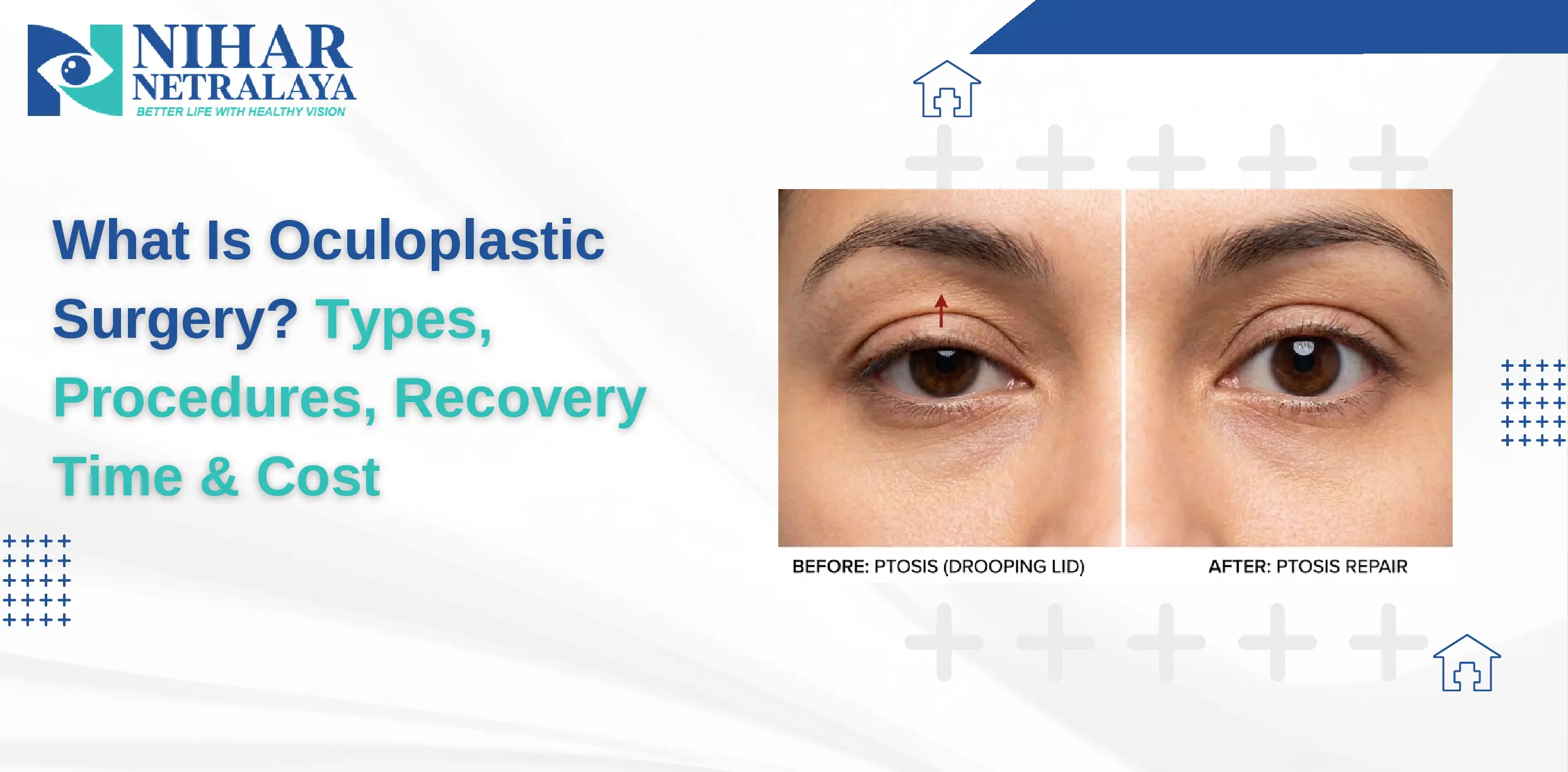
Have you thought about why the area around your eye is important? This protects your vision and also serves as your primary aesthetic center of the face. But ageing and certain eye conditions can affect both the function and appearance of your eyes.
In our OPD, we see many patients who come to us for vision discomfort, continuous eye irritation, or are unhappy with their appearance. We guide them in oculoplastic surgery to solve these issues. But they are unaware of this term, their specific types and how we conduct this procedure.
So let’s understand oculoplastic surgery in simple terms to help you see better, feel better, and look refreshed.
What is Oculoplastic Surgery?
In simple terms, “oculo” is for the eye and “plasty” is for repair. Therefore, Oculoplastic surgery is done to improve and reconstruct the connected parts of the eyes, such as eyelid, orbit (eye socket), eyebrow and tear ducts.
It is commonly known as ophthalmic plastic surgery. Also referred to as “eye plastic surgery” or “cosmetic eye surgery”.
According to the International Society of Aesthetic Plastic Surgery, every year, over 2 million eyelid surgeries are performed worldwide, making oculoplastic procedures one of the most common eye treatments.
We perform oculoplastic surgery either for reconstruction (to fix medical problems) or for cosmetic improvement (to enhance appearance).
It can be done to correct damage from eye injury, disease, from birth conditions or for cosmetic reasons.
In children, certain eyelid or orbital conditions present from birth may also be addressed alongside pediatric ophthalmology care for comprehensive treatment
Conditions Treated with Oculoplastic Surgery
Sometimes changes around your eye are seen as minor, but they can require medical attention. An eye specialist closely checks your conditions to decide whether you require surgery or not.
Common conditions we treated with oculoplastic surgery include:
- When you feel vision issues due to a drooping eyelid, also called ptosis.
- You experience entropion (inward turning eyelid) or ectropion (outward turning eyelid).
- You notice continuous watering from the eyes, which can be due to a blocked tear duct.
- Brow ptosis condition where your eyebrow droops low.
- Extra growth of skin or fat tissue around your eyelid.
- Any swelling or lumps around the eyelid due to cancerous conditions(Ocular Oncology).
- If you experience any trauma or accident that causes an eye socket fracture or ocular trauma.
- When patients are dissatisfied with appearance due to wrinkles, scars or under-eye bag conditions
Did you know?
Research shows that most oculoplastic cases are related to the eyelids, about 38.5%. Orbital problems around 34.4%, while tear duct issues account for 19.8%.
Types of Oculoplastic Surgery
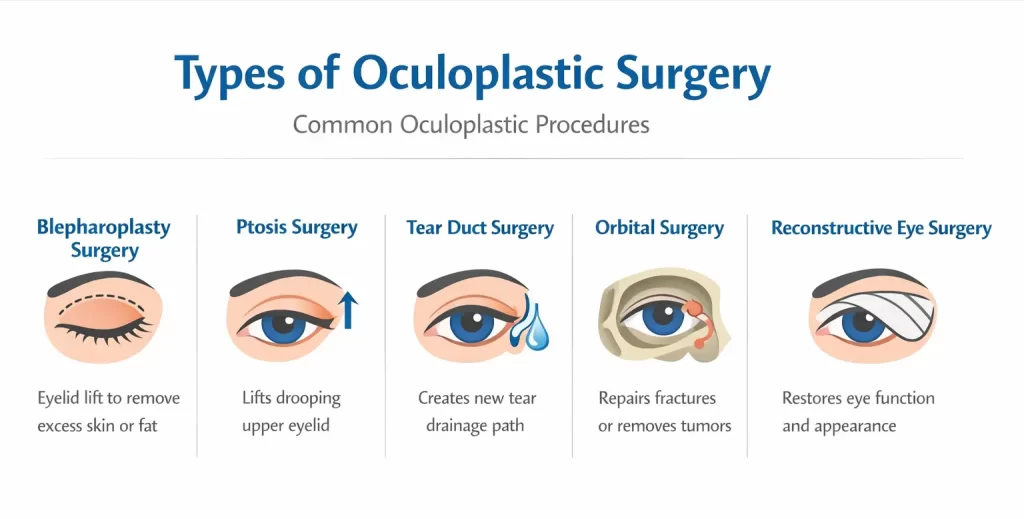
Here are the five most common oculoplastic surgeries we can do to treat both medical and cosmetic concerns around your eyes:
1. Blepharoplasty Surgery:
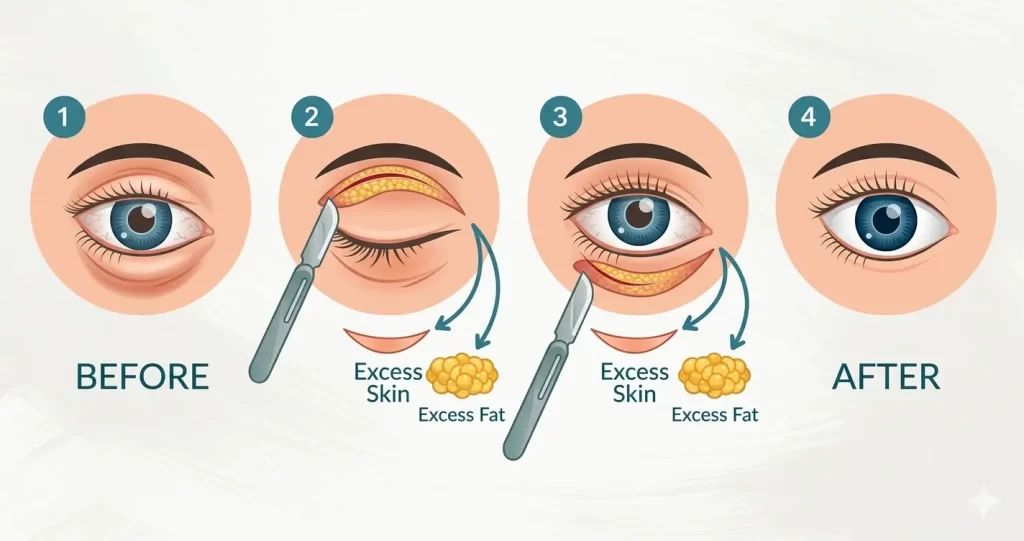
In this procedure, we gently remove extra skin or fat from your upper or lower eyelids. It reduces under-eye bags (puffy eyes) and improves a tired or aged appearance. It is also called an eyelid lift surgery.
2. Ptosis Surgery:
Your upper eyelid droops too low because a muscle becomes weak. We tighten that muscle, helping to clear your field of vision. This gives your eyes a much more open, refreshed, and natural look.
3. Tear Duct Surgery (Dacryocystorhinostomy):
If your eyes are watering constantly because of a blockage, Tear Duct Surgery (Dacryocystorhinostomy) helps. We create a new path so your tears can drain properly again. It’s a safe, effective way to get lasting relief and feel better.
4. Orbital Surgery:
The orbit is the bony “home” that protects your eye. We perform orbital surgery to fix things like fractures, tumors, or swelling that affect your eye’s position and health.
Patients with orbital issues sometimes report overlapping symptoms learning about early signs of glaucoma can help you stay informed and seek timely care.
5. Reconstructive Eye Surgery:
This is all about repair. Whether it is from an eye injury, a growth, or something you were born with. We work to fix the structure around your eye so it functions properly and looks natural again.
In cases where the eye surface is also affected, this may be planned alongside cornea surgery for complete restoration.
Every person’s eyes are different, so the right choices of procedure depend on your unique needs and what you are hoping to achieve.
How Is Oculoplastic Surgery Performed?

Oculoplastic surgery begins with a full check-up. We examine your eyes first and hear your concerns. Some patients get diagnostic scans or tests if it helps us to find the issue better.
Before the operation, we share simple instructions on medications, diet, and daily habits for good results. On surgery day, we use local or general anaesthesia, based on types of surgery.
Each surgical procedure is different, from eyelid lifts to eye socket fixes or opening tear ducts. We use tiny, hidden incisions to keep scarring minimal. Surgery takes around 30 minutes to a few hours, depending on the complexity.
We also schedule follow-up visits, help ensure proper healing and achieve long-lasting results.
Oculoplastic Surgery Recovery Time
Recovery from oculoplastic surgery varies by procedure type. Most patients start to recover in the first week. Swelling after eyelid surgery and bruising after eye surgery are very common. These are mostly noticed in the first few days after surgery, then settle down gradually.
At the end of week two, mostly visible signs improve, and you can get back to your normal routine. While full healing can take a few months, it depends on proper care, rest, avoiding strain, and attending follow-up visits.
Oculoplastic Surgery Cost in India
Oculoplastic surgery in India costs between ₹25,000 and ₹1,50,000. Price depends on procedure type, surgeon skill, and hospital setup. Cosmetic eye surgery and ptosis surgery prices can differ. Oculoplastic surgery cost in Indore is lower than in big cities, while maintaining quality care.
Oculoplastic Surgery Cost in Indore
At Nihar Netralaya, oculoplastic surgery cost in Indore ranges between ₹30,000 to ₹2,50,000, depending on the type and complexity of the procedure. Simple eyelid surgeries usually cost less, while advanced procedures like orbital or reconstructive surgery may be higher. The final cost also depends on the evaluation, surgical approach, and hospital care involved.
Experienced Oculoplastic Surgeon in Indore at Nihar Netralaya

At Nihar Netralaya Indore we have an experienced oculoplastic surgeon known for his patient‑focused and advanced care. He specializes in eyelid plastic surgery, ptosis correction, tear duct surgery, and orbital surgical procedures. With modern techniques and a gentle approach, he ensures safe results, minimal discomfort, and natural outcomes.
Oculoplastic surgery restores both eye health and appearance. It treats eyelid, tear duct, and orbital issues with safe techniques, minimal scars, steady recovery, and lasting functional and cosmetic benefits.
FAQs
The most common oculoplastic surgery is blepharoplasty (eyelid surgery). It is done to remove excess skin or fat from the eyelids, helping reduce puffiness and giving a more refreshed appearance.
Most patients recover within 7 to 14 days, when swelling and bruising start to settle. You can usually return to normal activities in about a week, while full healing may take a few weeks to a couple of months.
Most oculoplastic procedures take 30 minutes to 2 hours, depending on the type of surgery and complexity. Many procedures are done on an outpatient basis.
Yes, eyelid surgery can help you look more refreshed and youthful by removing excess skin and reducing under-eye bags. It improves both appearance and, in some cases, vision.
Results are usually long-lasting. Functional improvements are often permanent, while cosmetic results can last for many years, depending on ageing and lifestyle.
Most people consider eyelid surgery between the ages of 30 and 60, but it can be done earlier or later, depending on the condition and individual needs.
