

You may have never thought twice about your eyes until someone says,
“I think one of your eyes is turning.”
Or you notice it yourself in a recent photo and start comparing it with older ones.
As an adult, this can leave you wondering,
“Is something actually wrong, or just the way the photo was taken?”
“Could it be affecting my vision?”
One common reason is that one eye doesn’t stay aligned with the other; this is called a squint. It can occur from childhood or may even be noticed in adulthood.
In this guide, our expert ophthalmologist explains what squint eye in adults is, its causes, and how to fix cross eyes in adults.
What Is Squint Eye in Adults?
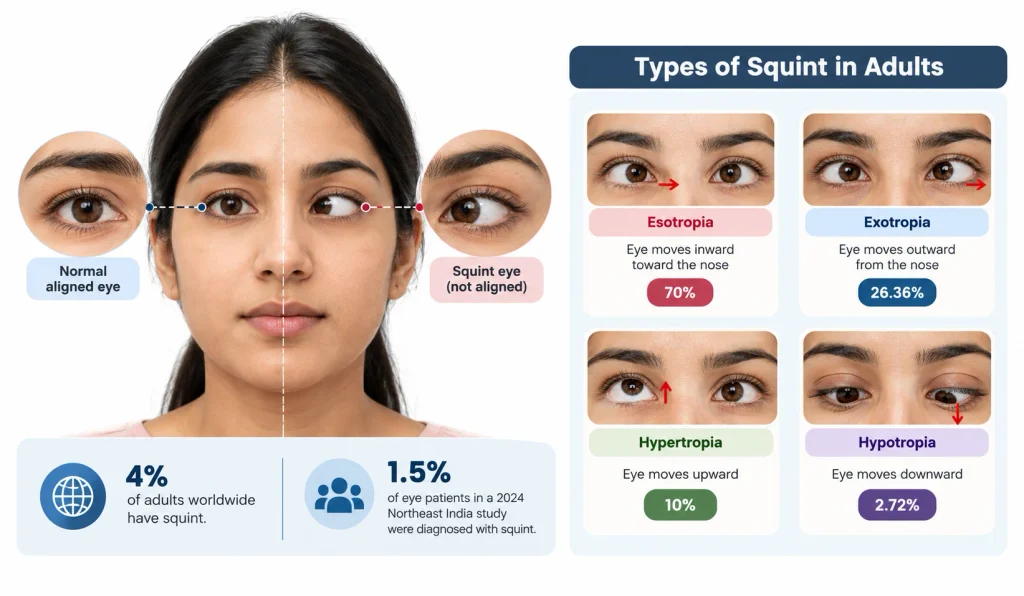
Squint, or strabismus, is a condition in which the two eyes cannot align and point in the same direction at the same time. Approximately 4% of adults worldwide have squint.
So, how do squint eyes appear? It depends on where the eyes are looking and which way they turn.
As per a study in the Journal of Family Medicine and Primary Care from Northeast India published in 2024, nearly 1.5% of the eye patients were diagnosed with squint. The study also showed that squint can present in different ways, with the following proportions observed in the patients studied.
| Types of Squint | What it means | Reported in the study |
| Esotropia | Eye moves inward toward the nose | 70% |
| Exotropia | Eye moves outward from the nose | 26.36% |
| Hypertropia | Eye moves upward | 10% |
| Hypotropia | Eye moves downward | 2.72% |
Squint Eye Symptoms in Adults
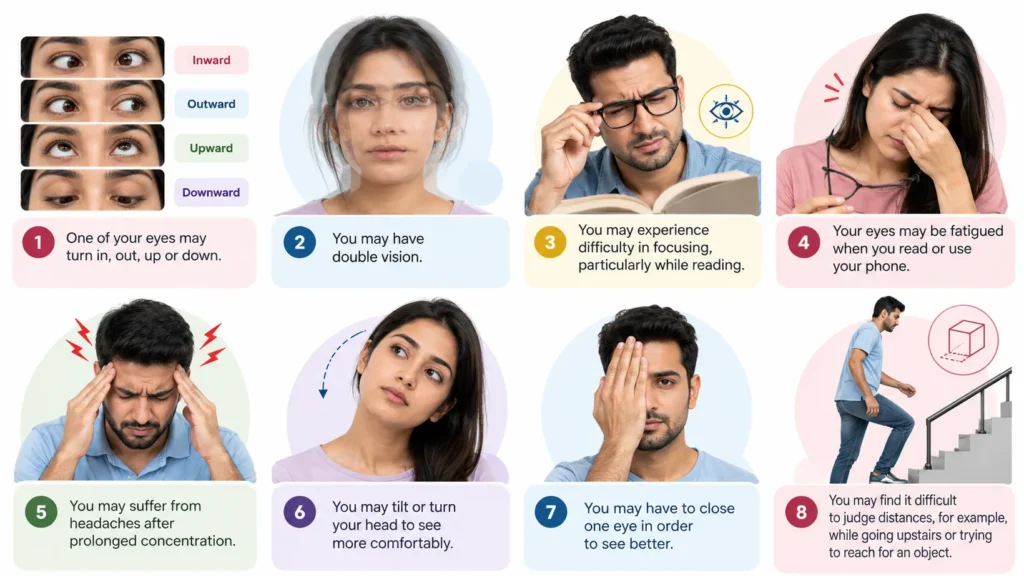
The signs of a squint can be different for each person.
You may notice:
- One of your eyes may turn in, out, up or down
- You may have double vision
- You may experience difficulty in focusing, particularly while reading
- Your eyes may be fatigued when you read or use your phone
- You may suffer from headaches after prolonged concentration
- You may tilt or turn your head to see more comfortably
- You may have to close one eye in order to see better
- You may find it difficult to judge distances, for example, while going upstairs or trying to reach for an object
Squint Eye Causes in Adults
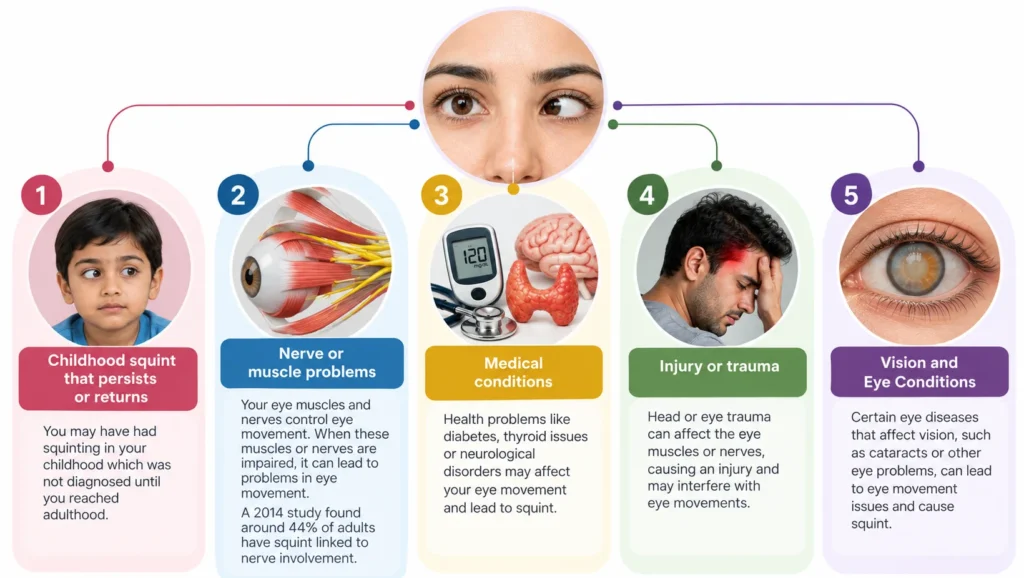
There is not always one clear reason why your eye starts turning.
Here we explain squint eye causes in adults:
1. Childhood squint that persists or returns:
It is possible that you had squinting in your childhood which was not diagnosed until you reached adulthood. If you want to understand how squint can develop earlier in life, you can also read about squint in children.
2. Nerve or muscle problems:
Your eye muscles and nerves are responsible for proper eye movement. When you have impaired function in either muscles or nerves, that can lead to impairment in your eye movement.
A 2014 study published in Ophthalmology claimed that around 44% of adults have squint eye that was linked to nerve involvement, which can be called Paralytic strabismus.
3. Medical conditions:
Your health problems, like diabetes, thyroid issues, or any neurological disorder that may have an effect on your eye movement.
4. Injury or trauma:
Head or eye trauma affects eye muscles or nerves, causing an injury and may interfere with eye movements. More serious eye injuries may require evaluation for ocular trauma surgery.
5. Vision and Eye Conditions:
Eye movement problems can occur due to some eye disease that causes visual problems to the person, such as cataracts or other eye problems. When cataracts significantly affect vision, treatment may involve cataract surgery depending on the individual eye condition.
How Is Squint Diagnosed in Adults?
At your squint examination, we may conduct some tests to identify your symptoms and understand how your eyes work together:
| Test | What We Check |
| Visual acuity testing | How your vision is at different distances by using an eye chart |
| Eye Alignment | How your eyes are positioned upwards, downwards or sideways |
| Eye movements | How your eyes can move |
| Cover and uncover tests | How one of your eyes reacts to the covering of the other eye |
| Binocular vision | How your eyes work together and check depth perception |
Squint Eye Treatment in Adults
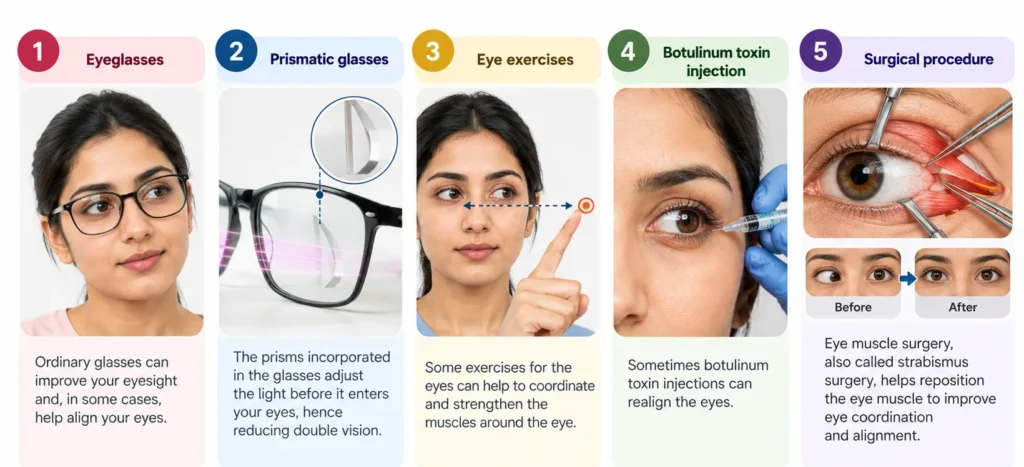
Squint eye treatment in adults depends on the type, cause, and severity of your squint.
Treatment may include:
- Eyeglasses: Ordinary glasses can improve your eyesight and, in some cases, help align your eyes.
- Prismatic glasses: The prisms incorporated in the glasses adjust the light before it enters your eyes, hence reducing double vision.
- Eye exercises: Some exercises for the eyes can help to coordinate and strengthen the muscles around the eye.
- Botulinum toxin injection: Sometimes botulinum toxin injections can realign the eyes.
- Surgical procedure: Eye muscle surgery, also called strabismus surgery, helps reposition the eye muscle to improve eye coordination and alignment. When surgery is recommended, the procedure may be referred to as squint surgery.
Can Squint Eye Be Corrected in Adults?
Yes, squint can be corrected in many adults, even if they have had it since an early age or it developed later in life.
How successful squint surgery is in adults depends on factors such as the type and cause of the squint, eye alignment, and your individual condition. Your ophthalmologist may first identify the underlying cause and then discuss the most suitable option.
Exercises for Squint Eyes in Adults
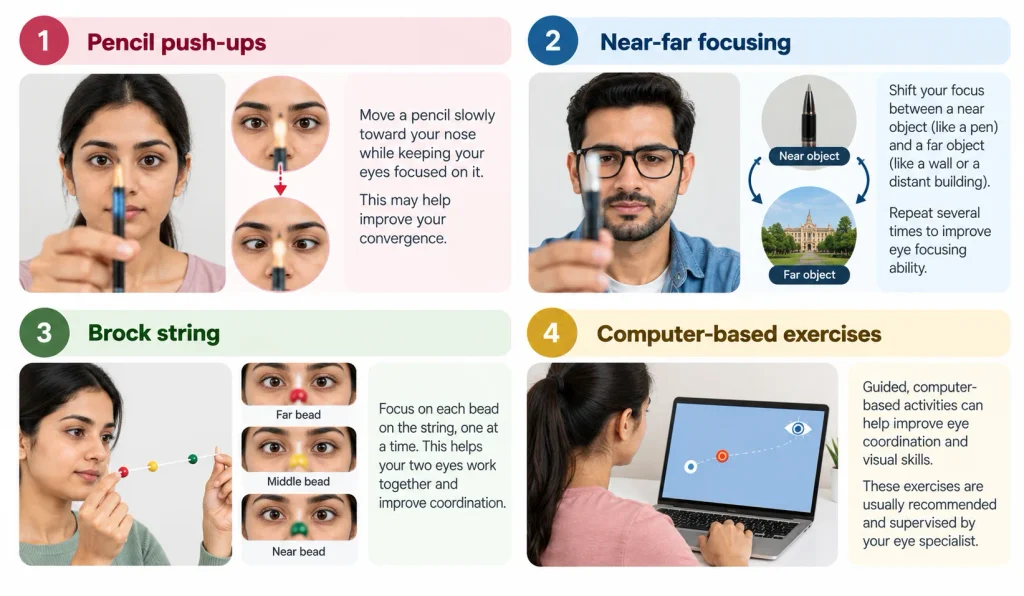
Exercises for squint eyes in adults may help selected eye-coordination problems, but they cannot correct every type of squint.
Your eye specialist may recommend:
- Pencil push-ups: These may help you improve your convergence by moving a pencil toward your nose.
- Near-far focusing: This includes shifting your focus from near to far objects.
- Brock string: This helps in making your two eyes work together.
- Computer-based exercises: Guided activities for better eye coordination.
Can Squint Eyes Be Corrected Naturally?
If you are wondering how to correct squint eyes in adults naturally, you may find many home remedies online. However, no proven natural remedy can permanently correct every type of squint.
Simple eye habits and prescribed exercises may help with comfort or coordination in some cases. See an ophthalmologist before trying any treatment on your own.
Why Choose Nihar Netralaya for Squint Eye Treatment in Indore

At Nihar Netralaya, Dr Mahesh Garg combines detailed clinical assessment with modern diagnostic approaches to understand adult squint more precisely. Rather than treating every patient the same way, our team reviews your eye alignment, vision, and symptoms before planning care.
You can discuss your concerns openly with our team and understand what your eye examination means for you, without feeling rushed or overwhelmed.
Conclusion
If you have noticed one eye turning or your vision feeling different, it is worth getting it checked rather than wondering about it. Adult squint can have different causes, and every person’s experience is different. A proper eye examination can help you understand what is happening with your eyes and give you a clear, practical way forward.
FAQs
Yes, squint can be corrected or managed in many adults. The appropriate treatment depends on the type, cause and severity of the eye misalignment. Depending on the individual case, treatment may include glasses, prism glasses, eye exercises, botulinum toxin injections or squint surgery.
No, squint surgery cannot guarantee 100% correction in every person. The outcome depends on factors such as the type and cause of the squint, the degree of eye misalignment and the individual’s eye condition. Some people may need additional treatment or a further procedure if the eyes remain misaligned or the squint returns.
There is no proven natural remedy that can permanently correct every type of adult squint. Certain prescribed eye exercises may help with eye coordination in selected cases, but they are not suitable for every type of strabismus. An ophthalmologist can determine whether exercises are appropriate for your condition.
Yes, a squint can return after surgery in some people. Eye alignment can change over time because of changes in the eye muscles, vision, nerve control or the underlying condition. If the squint returns, your ophthalmologist can assess whether glasses, prisms, exercises or another procedure may be appropriate.
The duration of squint surgery varies depending on the number of eye muscles being treated and the complexity of the misalignment. The actual procedure may take around 30 minutes to 1.5 hours in some cases, although the total time at the surgical facility can be longer because of preparation and recovery.
Most people need a short period of quiet rest after squint surgery, although recovery varies between individuals. Mild redness, soreness or a gritty sensation may occur during the early recovery period. Your ophthalmologist will advise you when to resume work, exercise, driving and other activities based on your recovery.
