
When patients come to the clinic for cataract surgery, their first concern is the surgery itself. Once they understand that cataract surgery is safe and effective, the next question is, “Doctor, which is the best lens for cataract surgery?”
So, I recently met a retired teacher who wanted to read her books without constantly reaching for glasses. Another patient, a businessman, was more concerned about clear distance vision for driving.
Although both patients underwent the same surgery, their vision needs were very different. That’s why there is no single “best” lens for cataract surgery. We recommend the lenses that suit your eye requirements and lifestyle.
In this article, we look at various lenses to help you select the most appropriate cataract lens after surgery.
Understanding Intraocular Lenses (IOLs)
According to a 2024 Indian study, nearly 15% of adults aged 50 years and older were affected by cataracts. As cataracts become more common with age, understanding the available treatment options and lens choices becomes increasingly important.
Although cataracts are most common in older adults, paediatric cataracts can also affect infants and children and require early treatment.
If you’ve noticed blurred vision or are unsure whether you have cataracts, learning about the early signs of cataracts can help you know when it’s time to see an eye specialist.
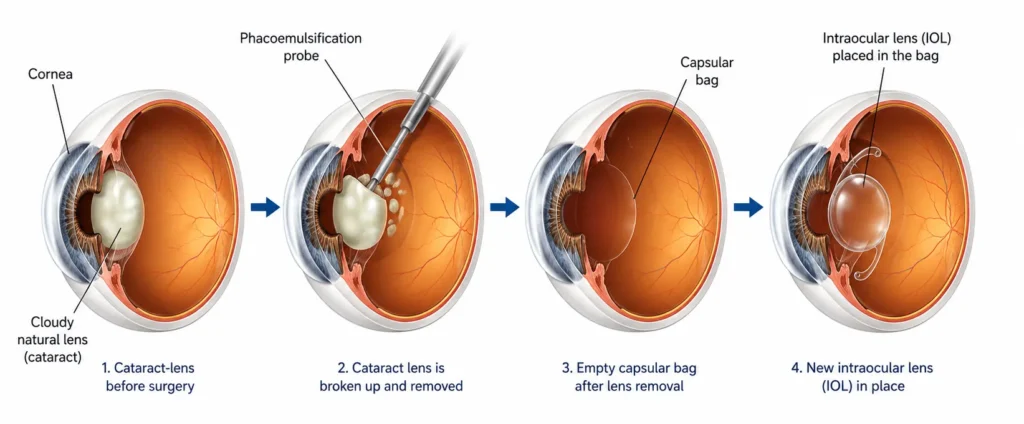
When you undergo cataract surgery, we remove the cloudy lens inside your eye and replace it with a clear artificial lens called an intraocular lens (IOL). The lens remains permanently and improves your vision.
These lenses are also used to correct refractive errors such as nearsightedness, farsightedness, astigmatism, and age-related difficulty reading nearby objects (presbyopia).
There are various materials that can be used to make this lens, including acrylic and silicone. Also coated with a special layer that helps shield your eyes from the sun’s harmful UV rays. During your eye examination, your ophthalmologist may also check for conditions such as glaucoma, which can affect long-term vision.
Types of Lenses for Cataract Surgery
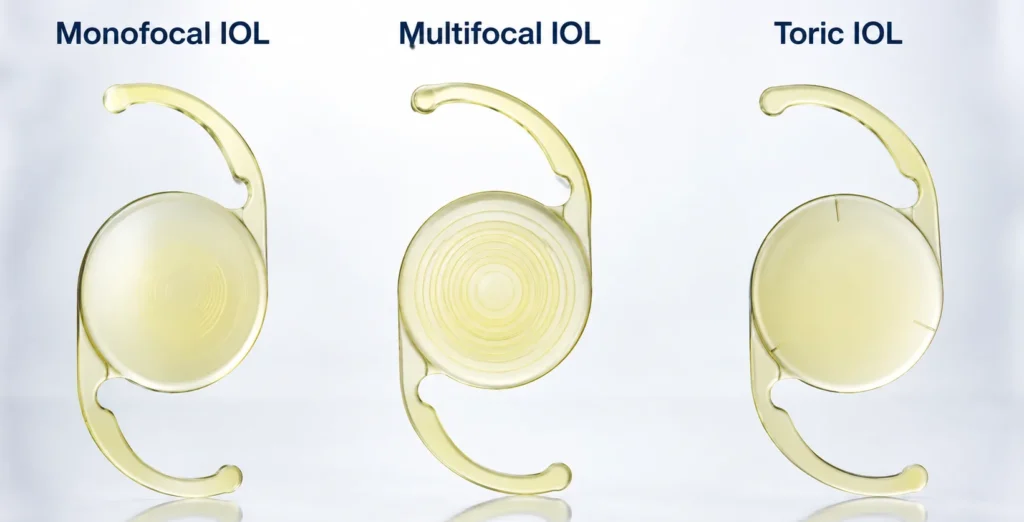
Nowadays, various advanced lens options are available to patients who are undergoing cataract surgery. These lenses are generally classified into the following three categories:
1. Monofocal Lens
2. Multifocal Lens
3. Toric Lens
There are certain advantages and disadvantages associated with each type. Let us now look at each lens type in more detail.
Monofocal Lens – The Most Common Cataract Lens

A Monofocal lens is the most common lens used in cataract surgery. It is the replacement of your cloudy lens with a clear one that allows you to see only at one fixed distance, most commonly for distant vision.
Key Benefits
- Accurate vision at a single distance
- High-quality clarity and sharpness
- Enhanced vision in low-light situations
- Relatively cheaper than premium lenses
Limitations
As the Monofocal lens focuses at just one point, most of the people still require glasses to read, use their mobile phones, and work on the computer.
Multifocal Lens – Reduced Dependence on Glasses

Multifocal Lens: A special lens that is used during cataract eye surgery. The multifocal lens replaces your natural lens and helps you achieve excellent vision at near, intermediate, and distance.
Key Advantages
- Nearly 3 out of 4 patients with multifocal lenses remained glasses-free after cataract surgery
- Improve your quality of life
- Helps you read or see on the phone screen without needing glasses
Disadvantages
- Patients with multifocal lenses may be 1.4 to 3.6 times more likely to experience glare or halos around lights compared to those with monofocal lenses.
- It may take time for your brain to adjust to the new vision.
Toric Lens – Best for Astigmatism
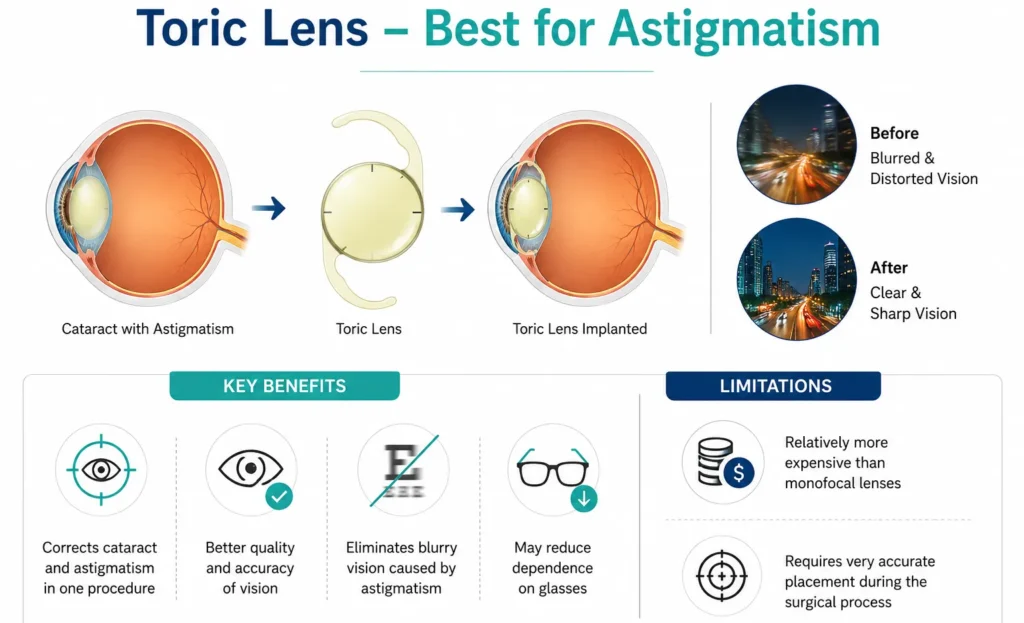
Toric lenses are specialised lenses that are used during cataract surgery when someone suffers from astigmatism. Astigmatism is a common vision disorder in which the curvature of your eye’s cornea or lens is imperfect, causing blurred or distorted vision.
Key Benefits
- Can fix vision defects that arise due to cataract and astigmatism in a single procedure
- Provides a better quality and accuracy of vision
- Removes blurry vision defects that may occur due to astigmatism
- May reduce the need for glasses by correcting pre-existing astigmatism during cataract surgery
Limitations
- It is relatively more expensive than monofocal lenses
- Requires very accurate placement during the surgical process
Monofocal vs Multifocal vs Toric Lens Comparison
During cataract consultations, many patients are surprised to learn that they have more than one lens option. Most patients want to know which is the best cataract lens in India. But the best cataract lens is not necessarily the most advanced or the most expensive; it is the lens that best matches your individual vision goals.
To make your choice easier, here is a clear side‑by‑side comparison of the most commonly used lenses:
| If You Want.. | Monofocal Lens | Multifocal Lens | Toric Lens |
| Clear distance vision | Very clear | Very clear | Very clear |
| Less dependence on glasses | You still need reading glasses | Often less need | May reduce the need for distance glasses |
| Reading and near tasks without glasses | Need glasses | Best option | Need glasses |
| Astigmatism correction | No | Limited | Made for this purpose |
| Night driving comfort | Very good | Some may see halos | Good |
| Budget‑friendly option | Most affordable | Premium lens | Mid‑to‑premium range |
If you’re still unsure which option suits your vision needs, this detailed guide on choosing the best IOL for cataract surgery explains the differences in greater depth.
Which Cataract Lens Is Best for You?
As cataract specialists, one of our most important roles is helping our patients choose a lens that supports their everyday visual needs.
The table below gives a clear overview of which patients may benefit most from each type of cataract lens.
| Lens Type | Commonly Recommended For |
| Monofocal Lens | If you want clear distance vision and are comfortable using glasses for reading or near work. |
| Multifocal Lens | When you want to be glasses-free and perform daily tasks that require both close and far vision. |
| Toric Lens | When you suffer from astigmatism and wish for sharper vision without the need for glasses post-surgery. |
Cataract Lens Cost in India
Cataract lens costs in India depend on the type of lens used and the surgical technique.
Typical price ranges:
- Monofocal lenses: ₹15,000 to ₹40,000
- Toric lenses: ₹35,000 to ₹80,000
- Multifocal lenses: ₹60,000 to ₹1,20,000
Apart from the lens itself, the overall cataract eye surgery cost also depends on the surgical technique, investigations, and the hospital where the procedure is performed.
Cataract Lens Cost in Indore
Cataract lens costs in Indore generally follow similar pricing trends and factors, but costs vary according to the hospital, the surgeon’s experience, the type of intraocular lens (IOL) selected, and the technology used during surgery.
The table below gives an approximate price range for different cataract lens options available at Nihar Netralaya, Indore.
Lens types and their cost at Nihar Netralaya in Indore:
- Monofocal lenses: ₹19,000 to ₹45,000
- Toric lenses: ₹33,000 to ₹65,000
- Multifocal lenses: ₹65,000 to ₹85,000
- EDOF / Trifocal Lens: ₹85,000 to ₹1,40,000
As eye specialists, we encourage you to pay attention not only to the costs but also to the quality of the services provided, as this can have a lasting impact on surgical outcomes and vision quality. Some patients also experience dry eye symptoms before surgery, which may need treatment for more accurate eye measurements.
Expert Cataract Care at Nihar Netralaya, Indore

At Nihar Netralaya, cataract surgery is not just about removing a cloudy lens; it is about helping you feel confident in your vision again. Our experienced cataract specialists use advanced technology, including retinal and diabetic eye evaluations, to guide you toward the lens that best suits your eyes.
Conclusion
Every patient’s vision journey is unique. While Monofocal, Multifocal, and Toric lenses each serve different purposes, the goal remains the same: helping you achieve clearer, more comfortable vision. With the right guidance and careful evaluation, cataract surgery can be a step toward seeing the world with greater confidence.
FAQs
A cataract lens, also known as an intraocular lens (IOL), is designed to last a lifetime. It is made from durable, biocompatible materials that do not wear out or need routine replacement. Although the artificial lens itself does not become cloudy again, some patients may develop posterior capsule opacification (PCO), often called a “secondary cataract,” which can usually be treated with a quick YAG laser procedure.
No. Cataracts cannot currently be reversed with medicines, eye drops, exercises, or home remedies. Surgery is the only proven treatment that removes the cloudy natural lens and replaces it with a clear artificial lens. In the early stages, stronger glasses or brighter lighting may temporarily improve vision, but they do not remove the cataract.
Yes, but replacing an intraocular lens is uncommon. Most cataract lenses remain in place for life. Lens replacement is usually considered only if there is an incorrect lens power, lens displacement, or another rare complication. Your eye surgeon will evaluate whether replacement is necessary.
Premium lenses such as Multifocal, Toric, EDOF, and Trifocal lenses can be worth the additional cost for patients who want greater independence from glasses or need astigmatism correction. However, they are not necessary for everyone. The right choice depends on your lifestyle, eye health, visual expectations, and budget. Your ophthalmologist can help determine whether the additional benefits justify the extra expense.
Monofocal lenses generally have the fewest visual side effects. They usually provide excellent distance vision with a lower risk of glare, halos, or reduced contrast sensitivity than multifocal lenses. However, most people will still need reading glasses for close work after surgery.
Mild blurry vision is common during the first few days as the eye heals. However, if vision becomes blurry months or years later, it may be caused by posterior capsule opacification (PCO), a common condition sometimes called a “secondary cataract.” This can usually be treated quickly with a painless YAG laser procedure. Sudden vision loss, severe pain, or increasing redness should be evaluated immediately by an eye specialist.

[…] of the three most common lenses, along with what each one costs in India, our guide on the best lens for cataract surgery covers that well. Here, we’ll go a level deeper into each type, including the specific brands […]